
Coastal Georgia storms hit hard. Trees feel every bit of that force.
Heavy rain, strong wind, and soaked soil can change a healthy tree in one night. A limb can split. A trunk can crack. Roots can loosen. Then a tree that looked fine the day before becomes a hazard over a roof or driveway.
That happens often across Midway, Richmond Hill, Hinesville, Savannah, and nearby Lowcountry communities. Large oaks, pines, and palms are part of the local setting. They give shade and privacy, but storm season puts real pressure on them.
Summit Tree and Land Solutions works across this region, so the crew sees the same storm patterns again and again. Trees rarely fail at random. Most show signs of stress first. The problem is that many of those signs are easy to miss from the ground.
Why Coastal Georgia trees take storm damage
The local weather plays a big role. Coastal Georgia deals with tropical storms, hurricane season, heavy summer rain, and sudden wind bursts. Soil can go from dry to saturated fast. That shift changes how roots hold the tree.
A tall tree depends on a stable root system. If the ground gets too wet, root support weakens. Then wind pushes against the canopy, and the trunk starts to move more than it should. Some trees recover. Others lean, split, or uproot.
Large canopies create another issue. A tree with wide heavy limbs catches more wind. Dense growth holds more water after rain. That extra weight adds strain to weak joints and damaged branches.
Palms have their own storm issues. Dead fronds can break loose and fall. Poorly maintained palms can drop debris across walkways, driveways, and yard spaces.
The most common types of storm damage
Storm damage does not always mean a tree fell in full. Many damaged trees stay standing at first.
Broken limbs are one of the most common problems. A large branch can snap, hang in the canopy, and stay there after the storm ends. That branch can fall later with no warning.
Cracked trunks are another serious issue. Some cracks run deep into the wood. Others show as new splits after heavy wind. Any fresh trunk crack needs a close look.
Leaning trees are a major warning sign too. A tree that suddenly leans after a storm may have root failure. Fresh lean, lifted roots, or cracked soil near the base all point to instability.
Then there are uprooted trees. These are easy to spot, but they are not the only emergency. A standing tree with hidden damage can be just as dangerous.
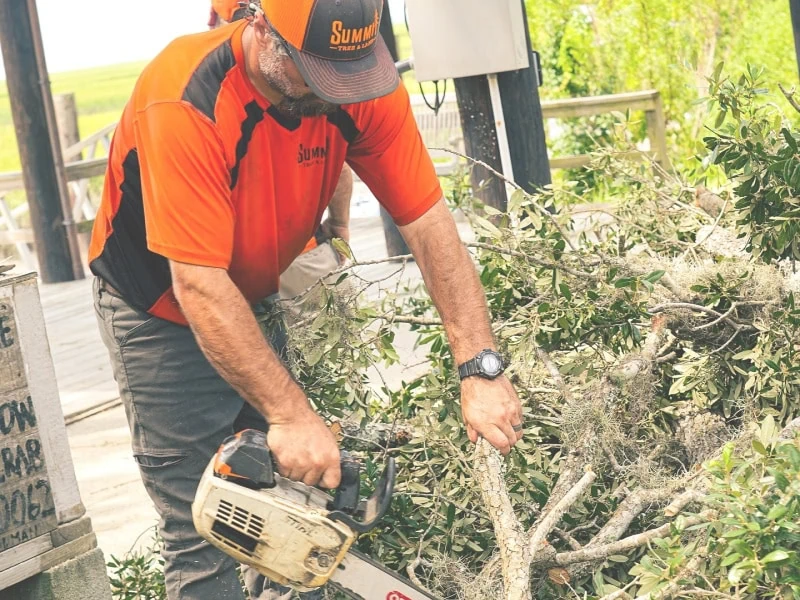
Summit Tree and Land Solutions handles all of these situations across Coastal Georgia, from broken limbs to full emergency removals. The crew works with both residential and commercial properties, and that matters in a region where storm damage can hit homes, rental properties, driveways, and business sites in the same weather event.
Signs of storm damage homeowners should look for
Start with the canopy. Look for hanging branches, missing limbs, fresh tears, or odd gaps where branches used to be.
Then check the trunk. Fresh cracks, split bark, and long vertical wounds all point to stress. If a tree now leans more than it did before the storm, treat that as a warning.
Move to the base. Look for lifted roots, mounded soil, or fresh ground cracks. These signs often show up after strong wind and wet soil work together.
Then look at what the tree is above. A damaged tree over a roof, garage, fence, driveway, or parked car carries more risk than the same tree in open space.
One question helps here. What would this tree hit if it failed tonight? The answer tells you how urgent the problem is.

Storm damage that stays hidden
Some tree damage is obvious. Some damage shows up later.
A tree can lose internal strength during a storm and still hold leaves for weeks. A branch union can crack and not fully separate until the next windy day. A root plate can shift just enough to weaken the tree without causing a full fall right away.
That is why post storm inspections matter. A tree that still stands is not always a safe tree. Homeowners often look for what has already fallen. A trained crew looks for what is likely to fall next.
Summit Tree and Land Solutions provides 24 hour emergency response across the Lowcountry. That service matters in part from timing, but it matters from experience too. A storm damaged tree does not always give much warning after the first failure.
What homeowners should do right after a storm
Start with safety. Stay away from hanging limbs, leaning trees, and damaged areas near the home. Do not walk under broken branches. Do not try to move heavy limbs with a saw from a ladder.
If a tree is on the house, keep clear of the damaged area. If power lines are involved, contact the utility provider first. A tree crew should not be the first call for active electrical danger.
Then look from a distance. Take note of trees that lean, trunks that split, limbs that hang, and driveways that are blocked. Photos help. Clear notes help too.
Then call a professional tree service that can respond fast and handle the job safely. Summit Tree and Land Solutions offers 24/7 emergency tree service and storm cleanup across Midway, Richmond Hill, Hinesville, Savannah, and the surrounding Coastal Georgia region.
Why timing matters after storm damage
A lot of storm damage gets worse with time. A hanging limb dries out and drops. A cracked tree keeps moving. Wet soil keeps giving way under a leaning trunk.
Fast action cuts risk. It can stop added damage to the home, driveway, fence, or nearby trees. It can restore access to the property sooner. It can reduce the chance of a second failure after the main storm passes.
This matters a lot in hurricane season. One storm can be followed by more rain or more wind within a day or two. A weakened tree rarely gets stronger during that time.
That is why Summit Tree and Land Solutions places strong focus on emergency response and storm cleanup in Coastal Georgia. The service is built for local weather, not just routine tree care.
When removal is the safer option
Some trees can be saved with trimming. Some cannot.
A tree with deep trunk cracks, major root failure, or a severe lean near a structure often needs removal. A tree that has lost large scaffold limbs may no longer have a stable canopy. A storm damaged tree over a roof or driveway may need crane assisted removal if access is tight or the wood is too unstable for standard methods.
Summit Tree and Land Solutions has crane assisted removal capability for large and dangerous trees. That is a major advantage in Coastal Georgia, where mature trees often grow close to homes and commercial properties. This equipment gives the crew more control over large sections and lowers the risk to nearby structures.
Storm cleanup is more than tree cutting
After the tree is down, the work is not over.
Storm cleanup often includes broken limbs, scattered brush, blocked access paths, and debris across the yard. A property can remain unsafe even after the largest tree section is removed.
Cleanup matters for safety and appearance, but it matters for access too. Cars need to get in and out. Walkways need to open back up. Outdoor areas need to be usable again.
Summit Tree and Land Solutions includes cleanup as part of the service. That detail shows up in the brand snapshot as one of the company’s strongest reputation signals. Customers notice clean work sites, and after storm damage that matters even more.
How routine care reduces storm risk
Storms cannot be stopped, but tree risk can be reduced.
Routine trimming removes dead branches before they fall. Thinning dense growth can reduce wind load. Crown reduction on long overextended limbs can lower stress on weak areas. Palm trimming removes dead fronds that can drop in wind.
This is one reason Summit Tree and Land Solutions offers both routine tree trimming and emergency response. The same crew that handles storm damage understands how to reduce storm risk before the next weather event hits.
Coastal Georgia properties need local tree knowledge
Tree service is local work. Coastal Georgia has its own weather pattern, tree mix, and property layout.
Midway, Richmond Hill, and Hinesville have a mix of rural lots, residential neighborhoods, and commercial sites. Savannah and the surrounding counties add tighter access, larger structures, and older mature trees. Palm trimming matters more here than it does in many inland markets. Crane capability matters more too.
That local context shapes how a crew plans removals, storm response, and cleanup. Summit Tree and Land Solutions serves this exact region and is built around those needs, from 24/7 emergency response to crane assisted removal and palm trimming.
Closing
Storms in Coastal Georgia can damage trees fast. Wind, rain, and wet soil can turn a healthy looking tree into a serious hazard. Broken limbs, trunk cracks, leaning trees, and root movement all deserve attention right away.
If a storm hit your property and a tree looks unsafe, do not wait for the next wind event to test it again. Quick action protects your home, your driveway, and the people who use that space every day.